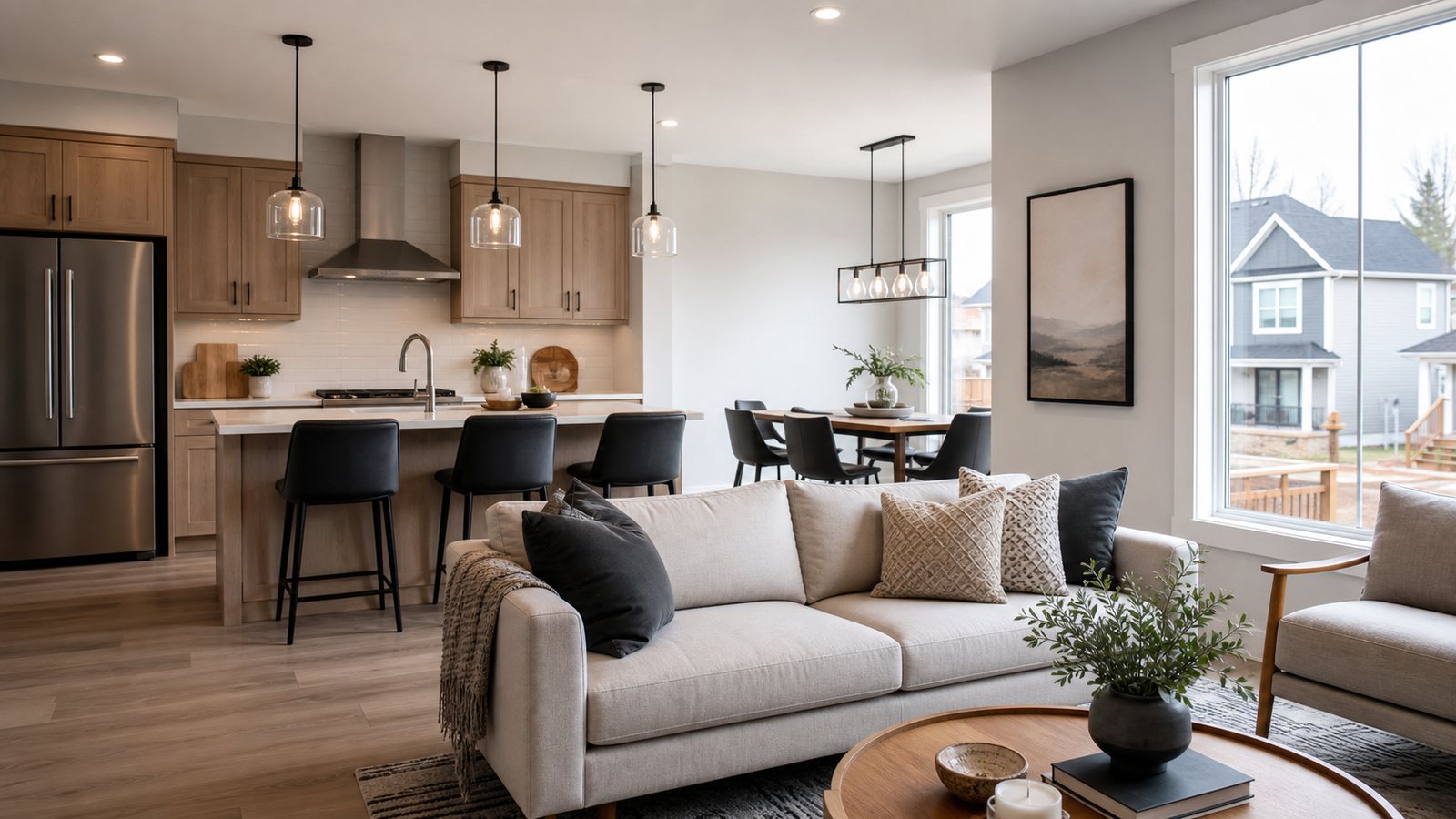
What a new-build sales centre won't tell you in Ottawa
A sales centre answers the questions you ask. It is nobody's job there to raise the ones you don't. Who the builder's agent across the desk works for, why agent registration on your first visit decides whether you can be represented, what the advertised price leaves out, and why the new build pressure you feel is structural.
By Ottawa Property Guide EditorialPublished July 31, 2026 Last verified July 31, 2026
A sales centre — the sales office, on the site plan — is a shop. It is purpose-built, professionally staffed, and for most of a new build's life it is the only place the product exists at all — there is no house to walk through, so the room has to do the work instead.
That is worth saying plainly, because buyers rarely arrive thinking of it as a shop. It feels like an information centre: there are site plans on the wall, a consultant with answers, brochures to take away. The information is generally accurate. What it is not is complete, and the gap between those two things is where new-build buyers get caught.
None of what follows is an accusation. Almost none of it is even unusual. It is simply what happens when one side of a transaction has done it ten thousand times and the other side is doing it once.
Who the builder's agent across the desk works for
The representative in a sales centre is employed by, or working for, the builder. Their obligation runs to the vendor. They are paid in connection with sales in that builder's communities, and not in connection with whether the purchase was a good idea for you.
That does not make them adversaries, and it does not make their answers untrue. It does mean their role has a shape: they will answer accurately what you ask about the homes they sell, and they have no reason to raise that a different community suits your commute better, that the lot backing onto the future arterial road is the reason it is cheaper, or that the incentive being offered this month is smaller than the one that ran in the spring.
Do I need a realtor for a new build? Agent registration closes the door on visit one
Most builders require a buyer's agent to register with that buyer on the first sales-centre visit. Walking in alone to "just look" can end the option of having someone in the transaction whose obligation runs to you — not because anyone tricked you, but because the registration rule is a condition of the builder paying that agent at all.
So the decision about representation has to be made before you start touring, not after you have fallen for a floor plan. And if you decide to go without an agent, do not assume the price improves to reflect it. Ask directly whether it does. In most cases the answer is no, because the cost sits in the builder's structure either way.
The advertised price is a starting number
The figure on the sign is a base price for a base house on an unspecified lot. Several things sit between it and the number on your closing statement, and nobody in the room is obliged to add them up for you:
The lot premium. Corner, walkout, pie-shaped, backing onto green space — desirable lots carry a charge, and it is not in the advertised price.
Upgrades and selections. The base specification is a real house, but the one you have been shown almost certainly is not it. See what's worth paying the builder for.
Closing adjustments. Development levies, utility connections, and other charges the agreement passes to the buyer. Ask whether they are capped, and at what.
How HST is treated. New homes carry HST, and the advertised price usually assumes a rebate that only applies on certain uses. If you are not moving in yourself, ask what changes.
What arrives when. Driveway, sod, fencing and appliances are sometimes months behind occupancy, and sometimes not included at all.
Ask for the finished number, in writing, for the specific lot and specific plan you are discussing. That request is entirely normal and it reframes the conversation immediately.
The model home is the best case, furnished
A model home is a showpiece: upgraded throughout, professionally staged, lit for viewing, and usually furnished with pieces scaled slightly small so rooms read larger. For every feature you like, the question is the same one — is this standard, or is it an upgrade, and what does that upgrade cost?
What isn't in the room: the land around your lot
The site plan on the wall shows the community. It does not show what happens on the land beside it. The empty field opposite, the future road allowance, the block zoned for higher density, the school that is planned but not funded — none of that is the sales centre's subject, and a representative selling homes is not the person who tracks it.
That information is public, and it comes from the City rather than the builder. Before committing to a specific lot, it is worth looking up what is permitted on the land around it — the official links hub collects the municipal and provincial sources in one place.
The contract is the builder's paper
A new-build agreement is the builder's own form, not the standard resale agreement, and the differences are substantive rather than cosmetic. Conditions a resale buyer would treat as routine — financing, inspection — are not necessarily present. Clauses allowing substitution of materials, adjustment of the closing date, or changes to the plan usually are.
This is the point in the process where a lawyer earns their fee, and the order matters: lawyer first, signature second. A ten-day rescission period applies to condominium purchases, which gives a short window to have the agreement reviewed after signing. Freehold purchases carry no equivalent statutory cooling-off period, so on a freehold home the review has to happen before you sign — see interim occupancy and closing for how the two timelines differ.
Dates move, and the paperwork decides who carries it
Construction timelines slip. That is ordinary, and the agreement anticipates it — the question is never whether a date can move but what notice you are owed when it does, and what happens to you meanwhile. Ontario's new-home warranty sets out rules on delayed closing and delayed occupancy, including compensation in defined circumstances; what Tarion actually covers explains the shape of it.
The practical version: ask what the firm date is, what the outside date is, and what you are entitled to if it is missed. Then ask where in the agreement those are written.
The deposit is larger, earlier, and structured
New-build deposits are bigger than resale deposits and are paid in instalments over months, long before there is a house to attach them to. What stands behind that money differs between freehold and condominium purchases, and it is worth understanding before the first cheque rather than after — new-build deposits covers the structure and the protection.
New build pressure is structural, not personal
Releases are sold in phases, prices step up between them, lots are held for short windows, and inventory genuinely does move. So when you are told the remaining lots are limited or that pricing changes at the next release, that is usually true. It is also how the product is sold — scarcity is a feature of a phased release, not an accident of one.
Knowing it is structural lets you take it seriously without letting it set your pace. A decision this size should survive a night at home with the paperwork. If it cannot, that is information too.
What to do instead
Decide the representation question before your first visit, not after.
Ask for the finished price in writing, for a named lot and a named plan.
Look up what the land around the community permits, using the City rather than the brochure.
Take every document home. Sign nothing in the room.
Send the agreement to a lawyer who has read new-build contracts before, and do it before signing wherever the purchase is freehold.
Check the builder's licence and record through the official directory linked from the builder directory.
For where the sales centre sits in the wider process, see the new build journey, step by step. The visit is one afternoon in a purchase that runs for a year or more — its job is to give you information, not to end with a signature.
Buying preconstruction is a different transaction from buying resale: the builder agreement is the builder's own paper, the home doesn't exist yet, and the timeline is measured in seasons. New vs resale, and the whole journey in the buyer's order.
The model home is a sales tool, not a price list. Here's how builder upgrades are priced, which ones you genuinely cannot add later, and why the appraisal doesn't always agree with what you spent. Which structural options close before the design studio, how a lot premium is separate again, and what upgrades are worth it against what you can do later for less.
A new-build deposit is bigger than a resale one, paid in stages over months, and handed to a builder long before there is a house. What stands behind that money depends on whether you are buying freehold or condominium — and since April 2026, partly on whether you filed one form. How staged deposits are scheduled, what Tarion deposit protection actually covers, and the deposit vs down payment distinction that catches most first-time buyers.
July 31, 2026Updated July 31, 2026
Get Ottawa property guidance in your inbox
You'll get: First-time buying explainers · Selling guidance · New-build and builder updates · Neighbourhood guides · Renting and ownership costs · Local market context.
Occasional emails. No spam, and you can unsubscribe with one click. By subscribing you consent to receive emails from Ottawa Property Guide. We record the date and source of your consent, as Canadian anti-spam law (CASL) requires. Read our privacy policy.