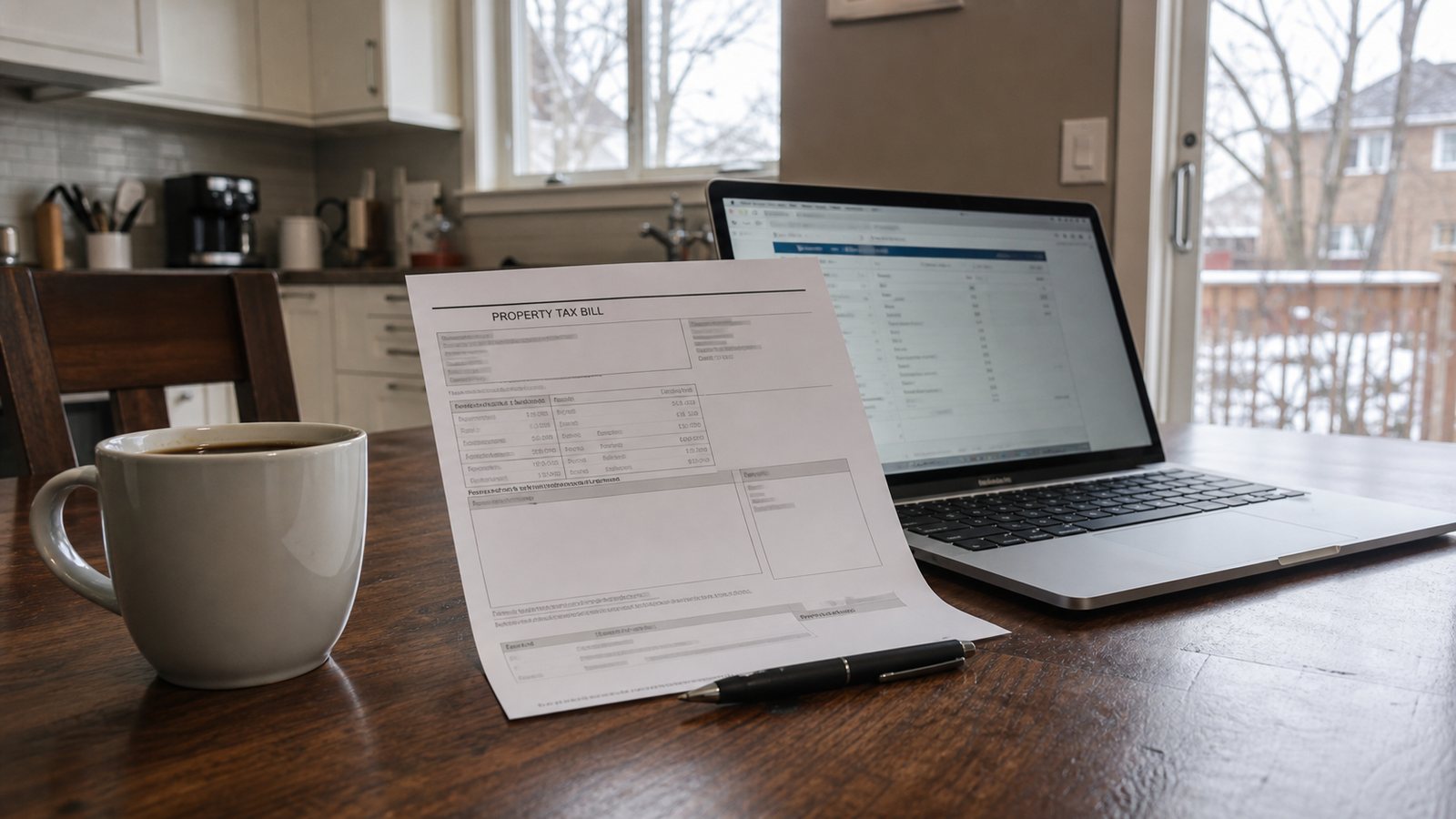
Ottawa property taxes and how assessments work — including why yours says 2016
Your property tax bill is your MPAC assessed value multiplied by two rates. The part that confuses everyone is the assessed value: Ontario's province-wide reassessment has been postponed for years, so assessments for the 2026 tax year are still based on 1 January 2016 values. What that means, what to do if the figure looks wrong, and what else is on the bill.
By Ottawa Property Guide EditorialPublished August 1, 2026 Last verified August 1, 2026
Property tax is the one housing cost that arrives every year forever, and almost nobody knows how the number is produced. It is worth ten minutes, because two of the three inputs are set by people you can talk to, and one of them can be challenged.
How are property taxes calculated in Ottawa?
The City of Ottawa is explicit about the components: residential property taxes are calculated using your assessed value, the municipal tax rate, and the education tax rate, which is set by the Province of Ontario.
So three inputs, from three different places. MPAC — the Municipal Property Assessment Corporation — sets the assessed value. City Council sets the municipal rate through the annual budget. The Province sets the education rate. Nobody sets your bill directly; it falls out of the three.
That has a consequence worth understanding: a rising assessment does not automatically mean a rising bill, and a frozen assessment does not mean a frozen bill. The municipal rate is adjusted against the total assessment base. What actually moves your bill is how your property's assessment changed relative to everyone else's, plus whatever the budget does to the rate.
Your MPAC assessed value is not market value — and why yours says 2016
This is the part that produces the most confusion in Ottawa, and the explanation is simpler than people expect.
Property assessments for the 2026 property tax year will continue to be based on fully phased-in January 1, 2016 current values.
MPAC, on the assessment cycle
Ontario postponed its province-wide reassessment during the pandemic, and on 16 August 2023 the government filed a regulation extending that postponement through the end of the 2021–2024 assessment cycle. The result is that the valuation date has stayed put. Your assessed value is an estimate of what the property was worth on 1 January 2016 — a decade ago.
Two things follow, and both matter.
Your assessment is not your market value, and it is not supposed to be. An assessment far below what you would sell for is completely normal and is not a bargain, an error, or a valuation of your home. Anyone using an assessed value as evidence of what a property is worth today is using the wrong number — what is my home worth is about the right one.
A whole decade of change is not in the base. Neighbourhoods that have moved a great deal since 2016 relative to the city average are carrying assessments that reflect a market that no longer exists. Whenever a reassessment does happen, that gap is where the bill changes will land — which is worth knowing if you are buying somewhere that has changed sharply.
How to appeal my assessment: the Request for Reconsideration
You can challenge it, free, through a Request for Reconsideration to MPAC. The important detail is the deadline: 31 March of the tax year. Miss it and you are waiting for next year.
MPAC aims to respond within 180 days, and if you disagree with its decision you then have 90 days to appeal to the Assessment Review Board. Property-specific evidence is required — an opinion that the number looks high is not enough. Useful evidence means comparable properties assessed differently, or a factual error in what MPAC holds about your home: the wrong square footage, a garage that does not exist, a basement recorded as finished when it is not.
Note what you are arguing about. You are challenging the 2016 valuation, not today's market, so "houses like mine now sell for more than this" is an argument against yourself. The form sits with the rest of the official forms and links.
Stormwater fee, school support, and what else is on an Ottawa bill
The tax line is not the whole bill. Depending on where the property is, an Ottawa bill can also carry a stormwater fee, a solid waste services fee, and area-specific levies — a conservation authority levy, volunteer fire services in some rural areas, and other local charges that appear as codes on the bill.
There is also school support, which directs the education portion of your taxes to the school system you designate. It does not change the amount you pay; it changes where that share goes.
For a buyer, the practical point is to get the actual annual figure for the actual address rather than estimating from a rate — because the fees and levies attached to a specific property are not something you can reason your way to. That number belongs in the affordability arithmetic from the start, alongside everything in Ottawa closing costs explained.
Relief, deferrals and rebates
The City runs full and partial property tax deferral programmes for low-income seniors and low-income people with disabilities, with income and assessment thresholds and interest on the deferred amount. It is a real option for an owner whose pressure to sell is the annual bill rather than the house — the criteria and the deadlines are set out in downsizing and aging in place.
There are also provincial programmes that operate through the income tax system rather than the tax bill, and vacancy or charity rebates for particular circumstances. None of it is automatic. All of it requires applying.
The tax adjustment on closing, when you buy or sell
Property tax is charged for the calendar year, and a sale rarely lands on 1 January. So on closing your lawyer calculates an adjustment: if the seller has already paid past the closing date, you reimburse them for the part of the year you will own it, and if they have not, the credit runs the other way.
It is a small number relative to the purchase but it is real cash on closing day, and it is one of the reasons the amount you need at closing is never exactly what you expected. Title insurance and what your lawyer does covers the rest of the adjustments.
One last thing worth doing the week you move in: confirm how the account is set up and whether the taxes are paid directly or through your mortgage. Both are normal. Not knowing which is how people miss a bill in their first year.
Three mortgage decisions that arrive years apart and are usually made in a hurry. What a fixed or variable rate actually buys you, why renewal is the moment most owners quietly give away money — including a 2024 rule change that made switching lenders easier — and how a prepayment penalty and the interest rate differential are calculated, before you need to know.
Selling the family home and moving in later life is usually framed as releasing equity, and the arithmetic is less generous than people expect once transaction costs and condo fees are counted. What a move actually frees up, what adapting the home costs instead, and the City of Ottawa tax deferral that lets some owners stay put — with the 2026 thresholds stated.
What do I pay on closing? The purchase price is only the headline number. Between the accepted offer and closing day, a cluster of hidden costs comes due — land transfer tax, lawyer fees and disbursements, title insurance, adjustments and the repair buffer nobody budgets for.
Before you can price my home becomes how to price it, you need a home value you can defend. How comparables — comps — actually produce a market value, why a valuation, a home evaluation and a lender's appraisal are three different things, what overpricing costs in time on market, and the best time to sell in Ottawa.
July 23, 2026
Get Ottawa property guidance in your inbox
You'll get: First-time buying explainers · Selling guidance · New-build and builder updates · Neighbourhood guides · Renting and ownership costs · Local market context.
Occasional emails. No spam, and you can unsubscribe with one click. By subscribing you consent to receive emails from Ottawa Property Guide. We record the date and source of your consent, as Canadian anti-spam law (CASL) requires. Read our privacy policy.