The Ottawa spring home maintenance checklist — find out what winter did before it costs you
Spring in Ottawa is not a gardening season, it is an inspection season. Five months of freeze-thaw, ice loading and road salt have just finished working on your house, and the melt is the one time of year the drainage problems show themselves. Here is the spring maintenance checklist in the order the thaw demands it — roof and ice-dam damage, the melt test, regrading the ground you could not touch in November, frost heave, and getting the air conditioning looked at before every technician in the city is booked.
By Ottawa Property Guide EditorialPublished August 2, 2026 Last verified August 2, 2026
Spring maintenance in Ottawa is mostly diagnosis. Between November and April the house took ice loading on the roof and gutters, five months of freeze-thaw on every exterior surface, salt on the walkways and a slab of frozen ground against the foundation. None of that damage announced itself at the time. The melt is when it does, and the melt is short.
So the order below is not the order of what is most satisfying to fix. It is the order of what you can only see or only do right now.
The melt test — do this one while the snow is still going
This is the single most valuable half-hour of the homeowner's year and it has a deadline. Once the snow is gone, so is the evidence.
Walk the perimeter during a heavy melt, ideally in rain. Watch where water actually goes rather than where you assume it goes.
Look for water pooling against the foundation or running toward it. Note the exact spots — that is your regrading list for six weeks from now.
Check window wells for standing water, and the basement side of those windows for damp.
Watch the downspouts discharge. If the extension has been knocked off by a plow or a shovel, the roof is now watering your foundation.
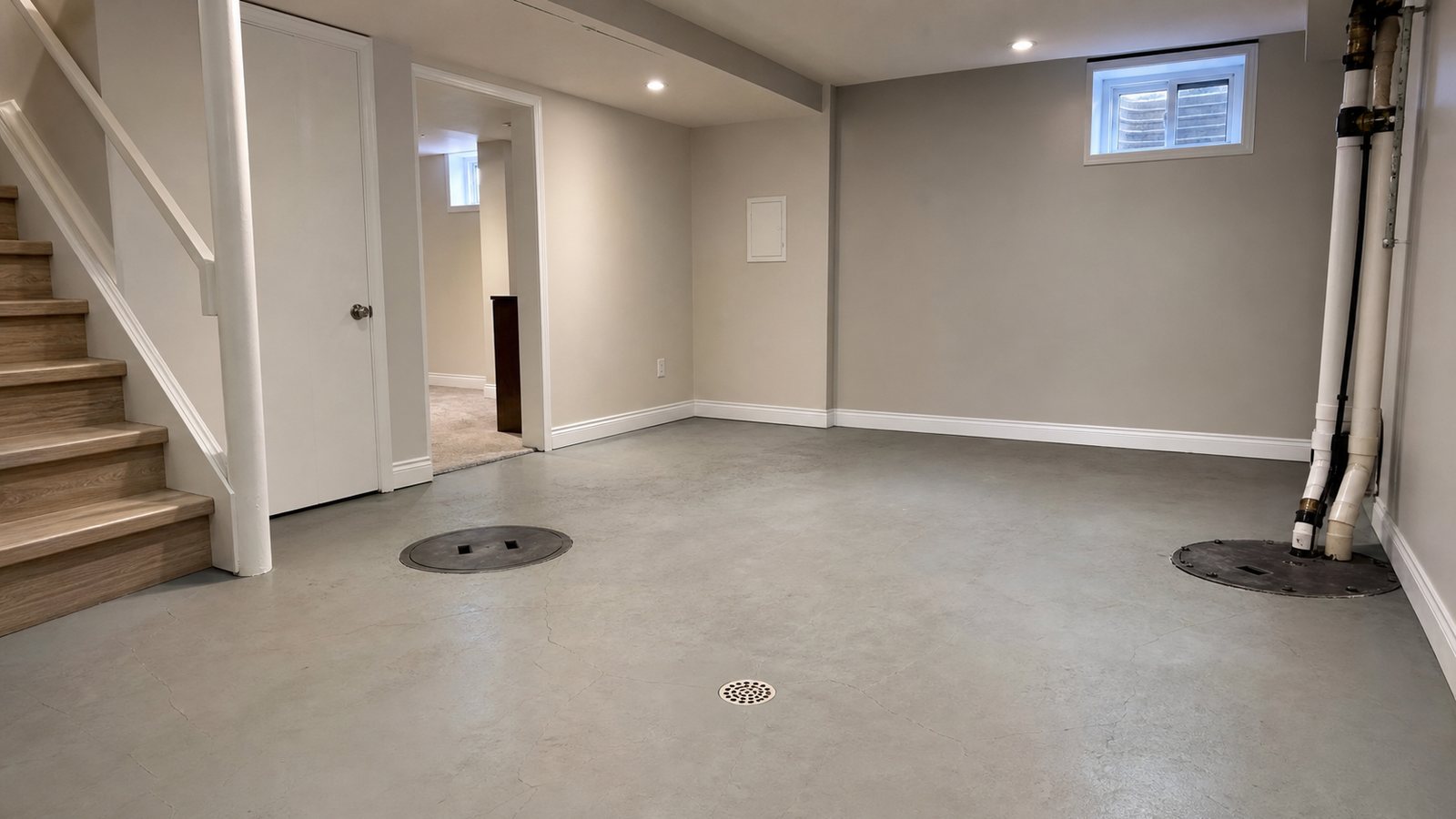
Go into the basement during the melt, not after it. Look and smell along the base of every wall, behind stored boxes, and under the stairs.
Check the sump pump runs, if you have one, and that its discharge is clear of ice and directed well away from the house.
The roof, the gutters and what the ice did
Do this from the ground with binoculars before anyone gets on a ladder. Most of what matters is visible from the lawn.
Look for lifted, curled or missing shingles, particularly along the lower edge where ice dams form and along ridges where wind gets under.
Check the eaves for staining or peeling paint on the soffit and fascia — that is the signature of an ice dam that backed water up under the shingles, and it means the problem is insulation and ventilation in the attic, not the roof itself.
Look at the gutters for sagging or pulled hangers. Ice is heavy; a gutter that survived February with a droop in it will overflow all summer.
Clear the gutters of the grit and shingle granules that come down over winter, then flush them and confirm water exits the bottom of each downspout.
Reattach or replace downspout extensions knocked off during snow clearing, and get them discharging well clear of the foundation.
Get into the attic on a bright day and look for daylight, damp sheathing, matted insulation or mould near the eaves. That is where an ice dam leaves its record.
Regrading — the job you were told in October to wait for
The fall checklist says regrading ends when the ground freezes. This is the other end of that sentence: once the ground has thawed and dried enough to work, the low spots you mapped during the melt are fixable, and the fix is usually soil and an afternoon rather than a contractor.
Top up settled soil so the ground falls away from the foundation on every side. Aim for a noticeable slope over the first two metres, not a subtle one.
Fill the gap where soil has shrunk back from the foundation wall over winter — that gap is a direct funnel to the footing.
Check the driveway and walkway for frost heave, cracks and lifted slabs. A slab that now tilts toward the house is a drainage problem wearing a trip-hazard costume.
Clear window wells of leaves and grit, and check their drainage.
Look at the interlock and steps for movement, and at retaining walls for bulging — winter is when they shift.
Air conditioning, before the first heat wave books every technician
The same dynamic as furnace service in the fall, in reverse. The first genuinely hot week in Ottawa is when everyone discovers their air conditioning does not work, and it is the worst possible week to be phoning around.
Book service in April or May, not in the last week of June.
Clear leaves, plastic and winter debris from around the outdoor condenser unit, and remove any cover before running it.
Change the furnace filter — the same blower runs the cooling, and a winter's filter is not going into summer with you.
Run the system on a mild day to confirm it cools before you actually need it to.
Check the condensate drain runs freely. A blocked one finds the ceiling below it.
If you have a heat pump, this is also its cooling-season check — and if you are considering one, the rebates are covered in home energy rebates and retrofits.
The salt, the exterior, and the things that were frozen shut
Rinse road salt off the lower siding, the garage door, walkways and any concrete it reached. Salt keeps working on concrete and metal long after winter.
Check exterior caulking and weatherstripping — freeze-thaw splits caulk, and what sealed in October may not seal now.
Reconnect and test outdoor faucets you drained in the fall. Turn the interior valve on and watch for leaks inside the wall, which is where a pipe that froze reveals itself.
Look for cracks in the foundation now that it is visible. Hairline cracks are common; anything you can fit a coin into, or that is wider at one end, is worth a professional opinion.
Test the GFCI outlets outdoors and in the garage.
Check the deck and fence for frost movement, loose boards and rot at the posts where snow sat all winter.
The bottom line
Spring is the only season that tells you the truth about the previous one. The melt shows you where water goes, the bare roof shows you what the ice did, and the thawed ground lets you fix the grading you could not touch in November — and all three windows close within about six weeks of each other. Work the list in that order and the rest of the year is maintenance rather than repair.
Three different problems get called a wet basement, they have different causes, different fixes and different insurance, and telling them apart is most of the work. What to look for at a viewing, and the City of Ottawa rebates that pay a large share of the fix — up to $3,000 for a sump pump and $2,500 for an outdoor storm backwater valve.
Ottawa winters don't forgive procrastination. A few weekends of fall work — furnace, gutters, grading, faucets, weatherstripping, and a snow plan — is the cheapest insurance a homeowner here can buy. Here's the full checklist, in the order the season demands it. Seasonal maintenance in the order it matters — and how to winterize before the freeze does it for you.
Every homeowner eventually hires someone in a hurry, at the worst moment, from the first name that answers. Ontario gives you a specific protection for exactly that: a contract signed in your home can be cancelled within 10 days, for any reason. How to choose a contractor when you have time — the contractor deposit, the insurance, the building permit for renovation work — and what changes in an emergency repair.
The federal grant most people still ask about is closed. What replaced it is income-tested. But the provincial rebates on a heat pump, insulation and windows are substantial and open to everyone, and the City of Ottawa lends against energy efficiency work at a fixed rate over twenty years, repaid through your property tax bill. The trap is sequencing: several of these have to be applied for before the work is done, not after.
Older Ottawa homes carry a short list of specific, findable problems: radon, knob and tube or aluminum wiring, vermiculite insulation, galvanized or lead plumbing, and a buried oil tank. None of them is a reason to walk away on its own. All of them are reasons to write a condition rather than waive one.
August 1, 2026
Get Ottawa property guidance in your inbox
You'll get: First-time buying explainers · Selling guidance · New-build and builder updates · Neighbourhood guides · Renting and ownership costs · Local market context.
Occasional emails. No spam, and you can unsubscribe with one click. By subscribing you consent to receive emails from Ottawa Property Guide. We record the date and source of your consent, as Canadian anti-spam law (CASL) requires. Read our privacy policy.