Relocating to Ottawa — from another province, within the NCR, or across the river to Gatineau
Three different moves get called relocating to Ottawa, and they have almost nothing in common. Arriving from another province means learning Ontario's closing costs. Moving across the river to Gatineau means changing province — a different tax, a notary instead of a lawyer, and a different everything else. And moving within the region is really a commute decision.
By Ottawa Property Guide EditorialPublished August 1, 2026 Last verified August 1, 2026
Moving to Ottawa describes at least three unrelated problems. Someone arriving from Vancouver or Halifax is learning a new market and a new set of closing costs. Someone moving from Ottawa to Gatineau is changing province, with everything that implies. And someone moving from Kanata to Orléans is making a commute decision dressed up as a house decision.
Moving from another province: what Ontario costs you at closing
The market is the easy part to research and the transaction is the part that surprises people, because closing costs differ substantially between provinces.
The big one is Ontario's land transfer tax, payable in cash on closing and scaling with the price. If you are coming from a province where it is cheaper or does not exist, it is a real number to find in your budget rather than a line item. First-time buyers get a refund of part of it, subject to the rules. The land transfer tax calculator gives you the figure for a specific price, and Ottawa closing costs explained sets out everything else that lands on the same day.
One piece of good news for a mover from Toronto: Ottawa has no separate municipal land transfer tax. Toronto charges its own on top of the provincial one; Ottawa does not, so the same price costs meaningfully less to transact here.
The other adjustments are structural rather than financial. Ontario purchases close through a lawyer, not a notary. Mortgage rules are federal and travel with you, but the property assessment system, the tenancy rules if you plan to rent out, and the new-home warranty regime are all provincial and all different from wherever you have come from.
And the geography is genuinely counter-intuitive from a distance: the city is large, it is split by a greenbelt, and the difference between a twenty-minute and a seventy-minute commute is not obvious from a map. What a budget buys across Ottawa is the fastest way to calibrate price against area.
Living in Gatineau, working in Ottawa: the river is a provincial border
Ottawa or Gatineau is the one decision unique to this region, and this cross-river choice is much bigger than the ten minutes it takes to cross a bridge. Buying in Gatineau means buying in Quebec, under a different legal system, a different tax system and a different language of daily administration.
The transaction itself works differently. Quebec real estate runs through a notary rather than a lawyer — and a notary must be involved where there is a mortgage, because only a notary can prepare a deed of hypothec for real estate. The notary examines the titles, prepares the deed of sale, and receives your down payment and the lender's advance before signing. If you have bought in Ontario before, this is a genuinely different process rather than the same process with different words.
There is a transfer duty, commonly called the welcome tax, payable on a purchase in Quebec. It is a municipal charge and the amount depends on the property and the municipality, so get the figure for the actual address rather than assuming it matches Ontario's land transfer tax.
Beyond the transaction, the differences are the ones that change daily life rather than closing day: provincial income tax, health care registration, driver's licensing and vehicle registration, school systems and the language of instruction, and childcare. Households routinely find that the property is cheaper and the arithmetic of living there is not what they assumed in either direction. Work it out for your own situation with proper advice rather than from a comparison someone posted online — the variables genuinely differ by household.
Moving within the National Capital Region
Moving from one part of the region to another is the most common relocation and the least researched, because people assume they already know the city. What actually changes is the commute, and it changes more than the map suggests.
The advice that matters is unglamorous: drive or ride the actual commute, at the actual time, in winter, before shortlisting an area. A route that is pleasant in September is a different proposition in February, and this is the single most common regret in a local move.
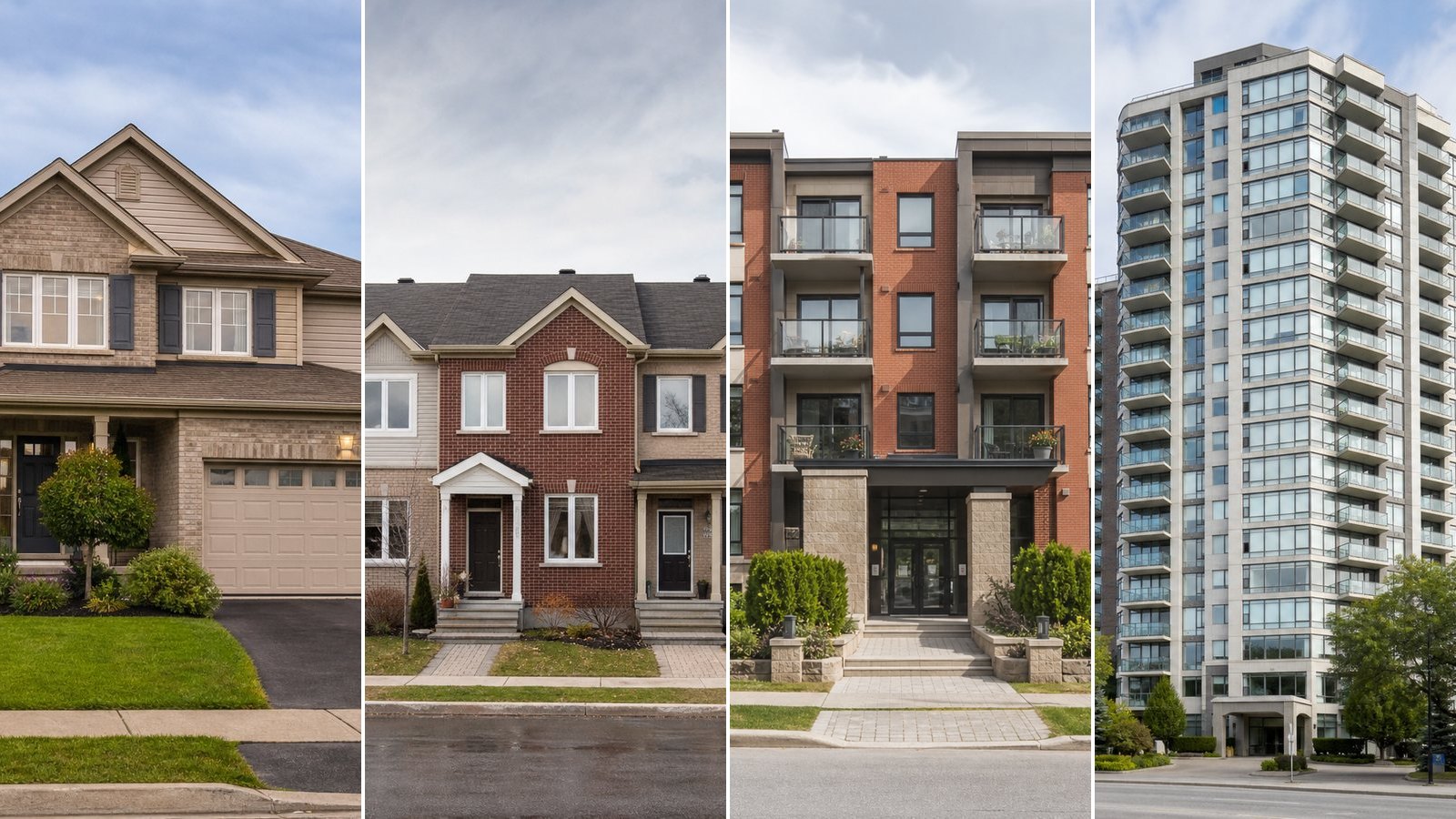
Beyond that, the useful comparisons are housing type and what the money buys — Ottawa housing types explained and the neighbourhood guides, which describe character and trade-offs without ranking anywhere.
Should I rent first? Usually yes, if you are moving from a distance
For a move from a distance, often yes — and it is worth saying because nobody selling you anything will say it. Renting for a year lets you learn the geography, test a commute, and buy on knowledge rather than on a weekend visit and a map. The cost is a year of rent and a second move; the benefit is not buying in the wrong place.
If you do rent first, the tenancy rules are Ontario's and they are worth knowing before you sign — renting a home in Ottawa covers the standard lease and your rights. If you rent in Gatineau, they are Quebec's instead, which is the same point about the border in a different form.
Before you commit
Budget Ontario's land transfer tax explicitly if you are arriving from another province — and note there is no municipal one on top in Ottawa.
Decide the province before the property if Gatineau is in scope. It changes the transaction, the taxes and the paperwork of daily life.
Drive the commute at the real time, in winter. Every local mover who regrets an area skipped this.
Get an Ontario lawyer lined up early — or a Quebec notary if you are buying across the river.
Consider renting for a year if you are moving from a distance, and treat that as a strategy rather than a failure.
Do not assume anything transfers: tenancy rules, warranty regimes, assessment systems and land transfer taxes are all provincial.
The common thread is that a relocation is two decisions wearing one coat — where to live, and under which set of rules. Separating them is most of the work.
Ottawa is mostly rural by area, and a country property replaces three things you never think about in the city: the water comes from your well, the waste goes into your septic system, and the road may belong to you and your neighbours. What to check before offering, who regulates what, and the free water testing most owners never use.
What my budget buys changes completely depending on where you point it. Hold a single number constant and move it around the city and it stops being a budget and becomes a set of trade-offs: space versus location versus age. Here is what you can get for it, by area.
What do I pay on closing? The purchase price is only the headline number. Between the accepted offer and closing day, a cluster of hidden costs comes due — land transfer tax, lawyer fees and disbursements, title insurance, adjustments and the repair buffer nobody budgets for.
Detached, semi, townhouse, stacked town, condo, apartment — listing sites assume you already know what these words mean and what they commit you to. Here's the plain-language version: what each type looks like, how the ownership works, and the trade-offs that actually shape daily life. What is a semi, how a town home differs from a stacked one, and the freehold vs condo distinction that matters more than the shape of the building.
July 22, 2026
Get Ottawa property guidance in your inbox
You'll get: First-time buying explainers · Selling guidance · New-build and builder updates · Neighbourhood guides · Renting and ownership costs · Local market context.
Occasional emails. No spam, and you can unsubscribe with one click. By subscribing you consent to receive emails from Ottawa Property Guide. We record the date and source of your consent, as Canadian anti-spam law (CASL) requires. Read our privacy policy.